Activities for 7-Month-Olds
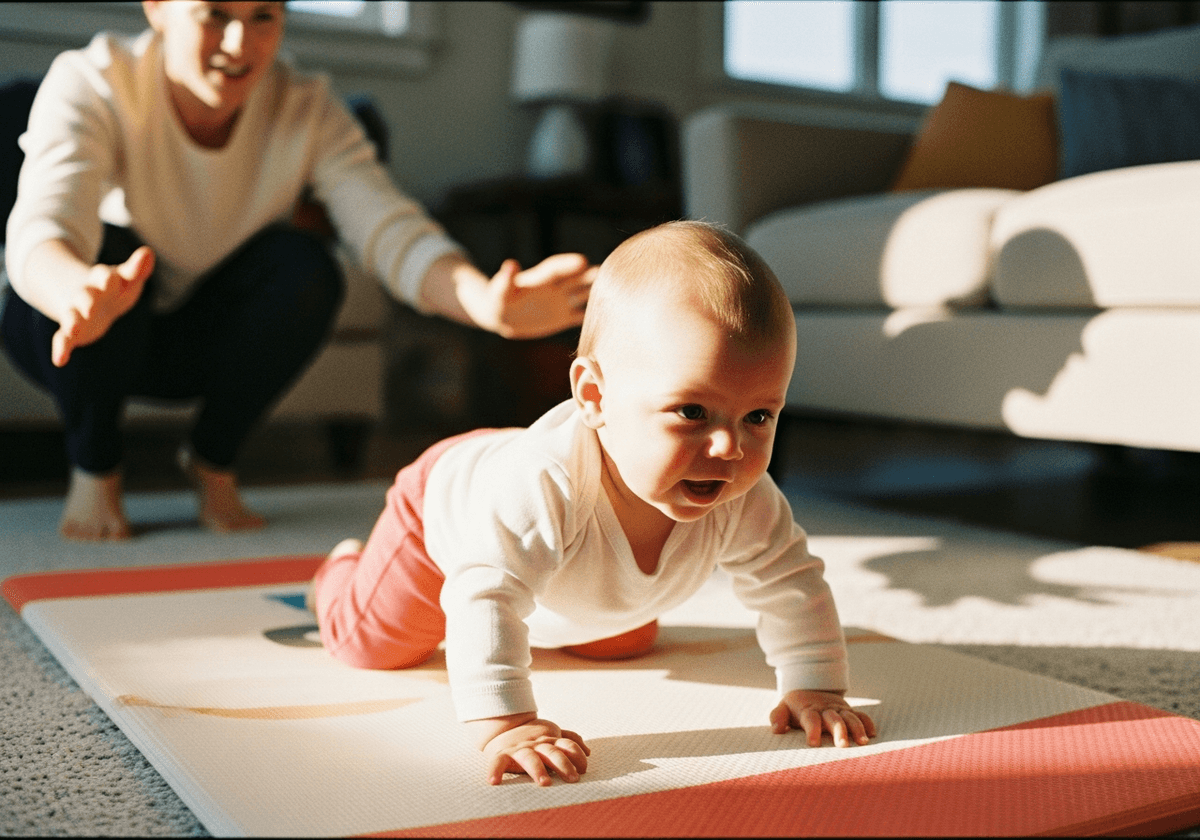
At seven months, your baby is on the move — or desperately trying to be. Whether they're army crawling, scooting on their bottom, or rocking on hands and knees, the drive to get from here to there is undeniable. This new mobility changes everything: your baby can now go to the things they want instead of waiting for you to bring things to them. It's their first real taste of independence.
What's Happening Right Now
🧠
Cognitive
Your baby understands object permanence well enough to search for completely hidden objects. They're experimenting with cause and effect through repetitive actions — dropping food from the high chair to watch it fall, banging toys together to make noise, shaking everything to see what happens. These aren't random behaviors; they're systematic experiments. Your baby is testing hypotheses about how the world works.
💪
Physical
Movement is the theme. Many babies are crawling, and those who aren't are finding creative alternative ways to get around. Pulling to stand on furniture is emerging. The pincer grasp is getting more refined, allowing your baby to pick up small objects with increasing precision. They can pass objects between hands easily and are starting to use objects as tools — pulling a blanket to bring a toy closer.
❤️
Social & Emotional
Stranger anxiety is typically at its strongest around 7-8 months. Your baby clearly distinguishes between familiar and unfamiliar people and may cry when held by someone they don't know well. They use gestures more intentionally — reaching to be picked up, pushing away things they don't want. They play social games like peek-a-boo with clear anticipation and delight.
⭐
What's Coming Next
Over the next couple of months, expect cruising along furniture, pointing at objects of interest, and first meaningful gestures like waving and clapping. Your baby may say their first word (or something that sounds close enough to count). They'll become increasingly skilled at self-feeding with finger foods.
Activities by Category
📚
Learning
These activities develop object permanence, spatial memory, and the early problem-solving skills that come from searching, finding, and figuring out simple puzzles.
🏃Physical / Motor
These activities develop pre-crawling coordination, strengthen shoulder and hip stability, and build the motor planning skills needed for intentional mobility.
🎨Creative / Art
These creative activities develop bilateral hand use, introduce mark-making as a concept, and encourage the exploratory play that is the origin of all artistic expression.
🧩Sensory
These activities develop advanced object manipulation, introduce concepts like full/empty and wet/dry, and support the proprioceptive awareness that helps your baby control their body.
👫Social
These activities support secure attachment during the stranger awareness phase, build confidence through familiar games, and develop the social memory that helps your baby trust.
💬Language
These activities encourage varied babbling patterns, build comprehension of simple words, and develop the gestural communication that bridges babbling and speech.
🎵Music
These musical activities develop coordinated rhythmic movement, encourage vocal play alongside music, and build the auditory memory that helps babies anticipate musical patterns.
🌿Nature / Outdoor
These outdoor experiences develop mobility on varied surfaces, introduce cause-and-effect through natural elements, and provide the sensory-motor challenges that drive brain development.
🤍
A Note for Parents
Baby-proofing becomes urgent now that your baby is mobile. But don't over-restrict their environment — they need safe space to explore, climb, and occasionally bump into things. Calculated risks are how they learn about their bodies and the physical world. A few bumps and tumbles are not failures of parenting; they're the price of developing independence.
What to Expect at This Age
Seven-month-olds are preparing to crawl, understanding object permanence, and using a raking grasp. They enjoy dropping and banging toys. Activities support pre-crawling movement, container play, and simple cause-and-effect games.
Curated Activities
Ready to Plan Your Week?
Create a personalized weekly plan with activities perfect for 7 months. Track milestones, save favorites, and keep your family engaged all week long.