Activities for 10-Month-Olds
Ten months brings a baby who is determined, mobile, and increasingly verbal. They stand, cruise, stack, and communicate with a growing repertoire of words and gestures. Your baby is developing preferences and opinions that they express with clarity — from the food they want to the game they insist on playing again. This is a person with a point of view, and it's only going to get stronger.
What's Happening Right Now
🧠
Cognitive
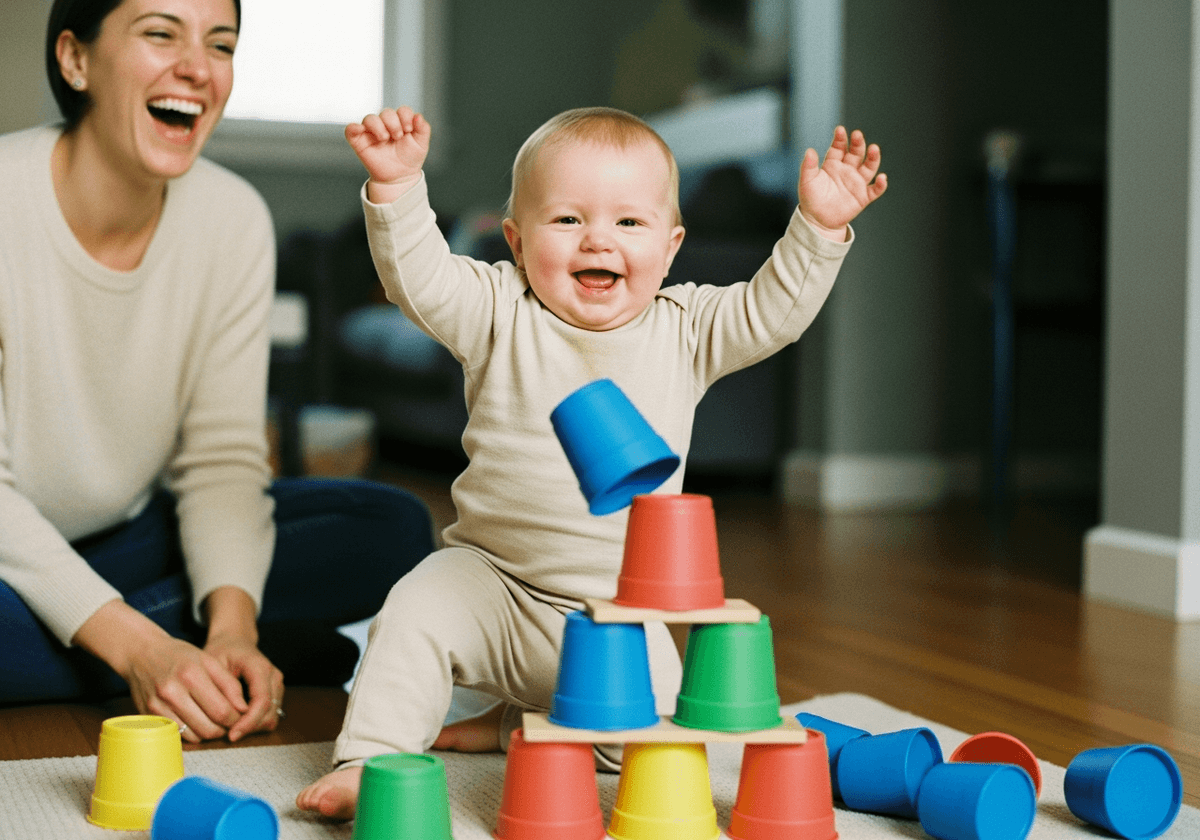
Your baby understands categories — they know that dogs and cats are different, even when they look nothing alike. They can follow simple instructions: 'Give it to Mama,' 'Show me the ball.' They experiment systematically, varying their actions to see different results. Stacking and nesting toys develop spatial reasoning. They remember where things are kept and will go looking for hidden favorites.
💪
Physical
Standing independently for brief moments, cruising with confidence, and possibly taking first steps while holding your hands. Your baby squats down to pick up objects and stands back up — a surprisingly complex sequence of balance and strength. They use a mature pincer grasp for self-feeding and can manipulate objects with increasing precision: turning pages, poking fingers into holes, fitting shapes.
❤️
Social & Emotional
Your baby brings you things to show you — a block, a leaf, a sock — not because they want you to take it, but because they want to share the experience. This declarative communication is a major social milestone. They play simple interactive games with you, laugh at silliness, and show empathy when others are upset (looking concerned, offering a toy to a crying baby).
⭐
What's Coming Next
Walking independently is right around the corner. Your baby's vocabulary will grow from a few words to dozens over the next several months. They'll start combining words into two-word phrases. Pretend play becomes more elaborate — feeding a doll, talking on a toy phone, stirring with a spoon. Tantrums may emerge as their desires outpace their ability to communicate.
Activities by Category
📚
Learning
These activities develop spatial reasoning, size discrimination, and the early mathematical concepts of ordering, grouping, and comparing.
🏃Physical / Motor
These activities strengthen leg muscles, develop dynamic standing balance, and build the confidence your baby needs to take those first independent steps.
🎨Creative / Art
These creative activities develop fine motor strength through art materials, encourage self-expression through color and form, and build the hand muscles needed for writing.
🧩Sensory
These activities build advanced sensory discrimination, develop tool use through sensory play, and support the self-regulation skills that come from satisfying sensory experiences.
👫Social
These activities develop social referencing, encourage imitative play, and build the shared attention that is the foundation of cooperative behavior.
💬Language
These activities encourage first word production, build gesture-word combinations, and develop the expressive communication skills that blossom in the toddler years.
🎵Music
These musical activities develop musical memory, encourage song request communication, and build the anticipation skills that come from knowing what comes next in a familiar song.
🌿Nature / Outdoor
These outdoor experiences develop fine motor skills through natural objects, build standing balance on varied surfaces, and provide the multisensory stimulation that enriches brain development.
🤍
A Note for Parents
When your baby brings you a toy or points excitedly at something, they're sharing their inner world with you. These moments of shared delight aren't interruptions — they're invitations to connect. Put down your phone, look where they're pointing, and respond with genuine interest. You're teaching them that their perspective matters and that connection is worth seeking.
What to Expect at This Age
Ten-month-olds stand briefly, stack and nest objects, and may say their first words. They love putting things in and out of containers. Activities encourage standing practice, stacking, nesting, and vocabulary building.
Curated Activities
Ready to Plan Your Week?
Create a personalized weekly plan with activities perfect for 10 months. Track milestones, save favorites, and keep your family engaged all week long.